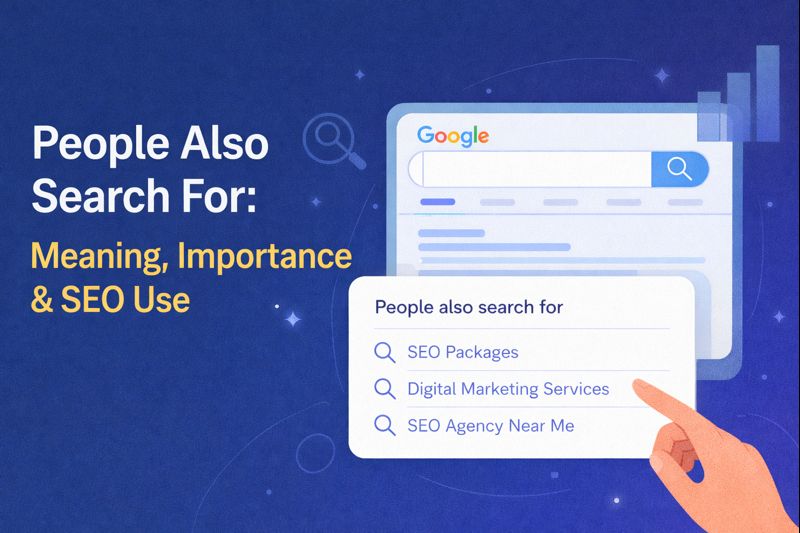
If you’ve ever searched something on Google, clicked a result, hit the back button, and then noticed a new box appear with related queries — congratulations, you’ve already seen People Also Search For in action.
Most people ignore it.
Smart SEOs don’t.
Because hidden inside that small box is pure search intent, straight from Google itself.
Let’s break it down in simple language — what People Also Search For means, why it matters for SEO, and how you can actually use it to grow traffic.
What Does “People Also Search For” Mean?
People Also Search For is a Google feature that shows related search queries after a user clicks a result and returns to the search page.
In simple words, it’s Google saying:
“Others who searched this also looked for these.”
It usually appears:
- When a user clicks a result and comes back quickly
- When Google thinks the first result didn’t fully solve the query
- When multiple related intents exist for one keyword
Example:
You search “SEO services”
You click a site
You come back
Now Google shows:
- people also searched for SEO packages
- people also searched for digital marketing services
- people also searched for SEO agency near me
That’s not random. That’s intent mapping.
People Also Search For vs People Also Ask
Many people confuse these two. They’re different.
| Feature | Purpose |
| People Also Ask | Question-based intent |
| People Also Search For | Follow-up or alternative intent |
People Also Ask helps you answer questions.
People Also Search For helps you expand topics.
If you want deeper content coverage, People Also Search For is gold.
Why “People Also Search For” Is Important for SEO
Here’s the truth most blogs won’t tell you.
Google doesn’t show these queries for fun.
It shows them because your main keyword alone is not enough.
1. It reveals real user intent
These are not tool-generated keywords.
These are based on actual user behavior.
If Google shows:
- people also searched for SEO audit checklist
It means users want more than a definition.
They want action.
That helps you improve content relevance.
2. It helps you rank for multiple keywords from one page
Instead of writing 10 small blogs, you can:
- Target one primary keyword
- Cover multiple “people also searched for” terms inside the same article
This improves:
- Keyword depth
- Topical authority
- Time on page
Which Google loves.
3. It reduces bounce rate
If users find all related answers on one page, they don’t go back to Google.
Lower pogo-sticking = better SEO signals.
4. It helps in content gap analysis
If your competitor ranks and Google still shows People Also Search For, it means:
Their content didn’t fully satisfy users.
That’s your opportunity.
Where Does Google Pull “People Also Search For” Data From?
Google doesn’t officially explain it, but based on SEO experiments, it comes from:
- User click behavior
- Search refinements
- Back button usage
- Query chains
- Similar search sessions
In short, human behavior at scale.
That’s why these keywords convert well.
How to Find “People Also Search For” Keywords (Step-by-Step)
You don’t need paid tools for this.
Method 1: Manual Google Search (Most Accurate)
- Search your main keyword
- Click any ranking page
- Hit the back button
- Look for the “People also search for” box
Note down every variation.
Method 2: Combine With People Also Ask
Open each People Also Ask question.
Scroll.
Click.
Google expands related searches further.
This helps you build a content cluster.
Method 3: Use It With SEO Tools (Optional)
Some tools scrape this data, but manual search still gives the cleanest intent.
How to Use People Also Search For in Your SEO Strategy
Now the important part.
Finding keywords is useless if you don’t use them properly.
1. Use them as H2 and H3 subheadings
If your main keyword is people also search for, then your subheadings can be:
- What does people also searched for mean
- Why people also search for appears
- How to use people also search for in SEO
This signals topic completeness.
2. Add them naturally inside content
Don’t stuff keywords.
Write like people talk.
Instead of:
“This article explains people also search for feature.”
Say:
“If you’ve noticed the people also searched for box after clicking a result, that’s exactly what we’re talking about.”
Feels human. Ranks better.
3. Use them for internal linking
If you’re running an SEO-focused site like Catlist Media, this is powerful.
You can naturally link to:
- SEO services →https://catlistmedia.com/services/search-engine-optimization/
- Content marketing →https://catlistmedia.com/content-marketing/
- PPC & performance marketing →https://catlistmedia.com/ppc-performance-marketing/
This improves topical authority across the site.
4. Use them to update old blogs
Old blog not ranking?
Check its People Also Search For terms.
Add missing sections.
Re-publish.
This alone can revive dead content.
Real Example: How It Improves Rankings
One of the simplest SEO wins we’ve seen at Catlist Media:
- A blog ranking on page 2
- Added 5 “people also searched for” subtopics
- Improved content flow
- Updated internal links
Result:
- Page moved to top 5
- Traffic increased without new backlinks
Sometimes SEO is not about doing more.
It’s about answering better.
Common Mistakes to Avoid
- Using People Also Search For as exact-match spam
- Writing separate blogs for every variation
- Ignoring search intent
- Copying competitor headings blindly
- Not updating content regularly
Google rewards usefulness, not keyword lists.
People Also Search For & Future SEO Trends
As AI search grows, Google will rely more on:
- Search journeys
- Follow-up intent
- Query chains
That means:
People Also Search For will matter even more.
If your content solves the next question before it’s asked, you win.
Final Takeaway
If you only optimize for one keyword, you’re already behind.
People Also Search For tells you:
- What users really want
- What your content is missing
- How to expand topics naturally
Use it well, and your content won’t just rank.
It will stick.
If you want help building SEO strategies that focus on intent, not tricks, connect with our team.
CTA: https://catlistmedia.com/contact/
FAQs: People Also Ask
What is people also search for in Google?
It’s a Google feature that shows related queries based on user behavior after clicking a search result.
Is people also search for good for SEO?
Yes. It helps identify real search intent and expand content for better rankings.
How is people also searched for different from people also ask?
People Also Ask shows questions. People Also Search For shows follow-up or alternative searches.
Can I rank for people also search for keywords?
Yes, by covering them naturally inside a well-structured blog.
Do SEO tools show people also search for data?
Some do, but manual Google search is still the most accurate way.