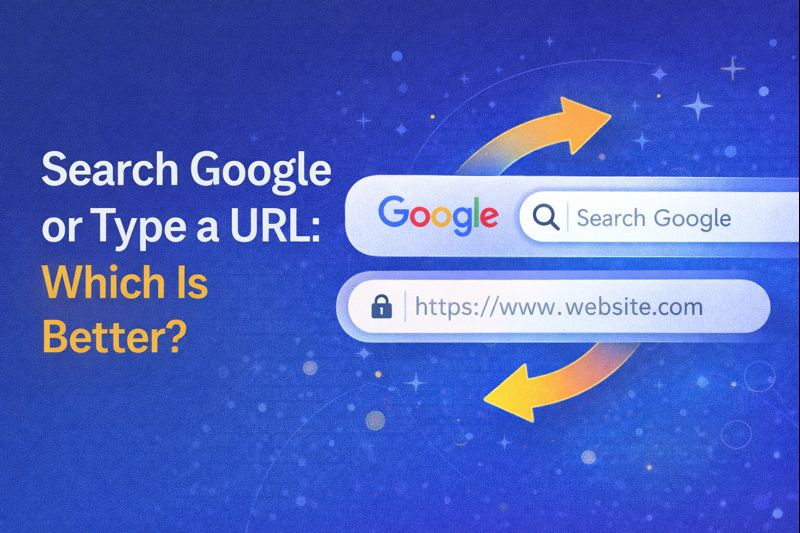
You’ve seen it thousands of times.
You open Chrome.
You click the address bar.
It says “Search Google or type a URL.”
And without thinking, you start typing.
But have you ever paused and wondered what’s actually better — search or type URL?
Does it make any difference at all?
Short answer: yes, it does.
Long answer: let’s break it down properly, without tech jargon.
What Does “Search Google or Type a URL” Actually Mean?
The Chrome address bar (also called the omnibox) works in two ways:
- You can search something on Google
- Or you can type a web address directly
- Chrome decides what you mean based on:
- What you type
- How you type it
- Your past behavior
- So when you see search google or type a url, Chrome is basically asking:
“Are you looking for information, or do you already know where you want to go?”
Search vs Type URL: What’s the Real Difference?
Let’s keep it simple.
| Action | What Happens |
| Search Google | Google shows you results |
| Type URL | Browser takes you directly to a site |
Both feel similar. But the intent is completely different.
When You Should Search Google
You should use search and type URL as a search when:- You don’t remember the exact website
- You want to compare options
- You’re researching something
- You’re discovering new brands
- Example searches:
- best digital marketing agency in Delhi
- SEO services pricing
- how SEO works
- This is where Google shines.
And this is exactly why SEO matters.
If you search something and your competitor shows up above you, that’s SEO doing its job.
👉 Learn more here:
https://catlistmedia.com/services/search-engine-optimization/
When Typing a URL Is Better
You should search or type web address directly when:- You know the exact website
- You visit it often
- You trust the source
- You want speed
- Examples:
- catlistmedia.com
- gmail.com
- youtube.com
- Typing the URL skips Google completely.
No ads. No distractions. Straight access.
This is where brand recall matters more than SEO.
Why Most People Don’t Type URLs Anymore
Let’s be honest.
Typing full URLs feels like work.
People now type:- “youtube” instead of youtube.com
- “amazon” instead of amazon.in
- “instagram login” instead of instagram.com
- That’s because Google has become the default navigation system of the internet.
This behaviour shift is important for marketers.
If people search your brand instead of typing your URL, Google controls that journey.
Search Google or Type a URL: Which Is Better for Users?
There’s no single winner. It depends on intent.
Use Search When:- You’re exploring
- You need options
- You want reviews or comparisons
- Type URL When:
- You know exactly where to go
- You value speed
- You trust the site
- Smart users do both.
Smart brands optimize for both.
What This Means for SEO & Digital Marketing
This simple Chrome message affects how traffic is distributed.
1. SEO Becomes Your Front Door
If users search instead of typing URLs, Google becomes the gatekeeper.
That means:- Ranking matters
- Click-through rate matters
- Content quality matters
- That’s why content marketing plays a big role:
https://catlistmedia.com/content-marketing/
2. Brand Searches Are Gold
When people search your brand name instead of your service, it’s a strong signal.
Example:- “Catlist Media SEO services”
- “Catlist Media digital marketing”
- This lowers your ad cost and improves trust.
3. Paid Ads Influence Search Behaviour
If users search instead of typing URLs, paid ads appear first.
This is where PPC & performance marketing steps in:
https://catlistmedia.com/ppc-performance-marketing/
What About “Search Google or Type a URL” Memes?
Yes, it’s a thing.
The phrase search google or type a url meme exists because people see it so often that it’s become internet culture.
But behind the meme is a real insight:
People rely on search more than memory.
For brands, that’s both an opportunity and a risk.
Search or Type URL in Chrome: How Chrome Decides
Chrome looks at:- Keywords vs domain patterns
- Dots (.) and slashes (/)
- Past visits
- Popular sites
- If you type:
- “catlistmedia” → Google search
- “catlistmedia.com” → direct visit
- Simple, but powerful.
Common Myths You Should Ignore
❌ Typing URL is always faster
❌ Searching is less secure
❌ SEO is useless if people type URLs
Reality:- Most users search
- Most journeys start on Google
- SEO + branding together work best
For Businesses: What Should You Focus On?
Here’s a simple strategy.
| Area | Focus |
| SEO | Rank for intent-based keywords |
| Branding | Build recall so users type your name |
| Content | Answer search queries clearly |
| Paid Ads | Capture high-intent searches |
| Bring users back without search |
Email is underrated here:
https://catlistmedia.com/email-marketing/
Final Takeaway
So, search google or type a url — which is better?
For users:
👉 Search when exploring, type when sure.
For brands:
👉 You must win both.
If people search, you need SEO.
If people type, you need a strong brand.
The smartest brands don’t choose one.
They build visibility everywhere.
If you want help building search visibility and brand recall, let’s talk.
CTA: https://catlistmedia.com/contact/
FAQs (People Also Ask)
What does search Google or type a URL mean?
It means you can either search on Google or directly enter a website address in the browser bar.
Is it better to search or type a URL?
Search is better for discovery. Typing a URL is better when you know the exact site.
Why does Chrome say search Google or type a URL?
Because the address bar works as both a search box and a URL field.
Does searching affect SEO?
Yes. Searches determine which websites get visibility and traffic.
Should businesses focus on SEO or branding?
Both. SEO brings discovery. Branding builds direct visits.